Conventional nanoscale electroplasmonic structures provide limited electrical tunability of nonlinear optical responses. Scientists at Japan's Institute for Molecular Science have demonstrated an angstrom-scale electroplasmonic platform enabling giant modulation (2000% V-1) of near-field nonlinear optical effects across a broad spectral range. The breakthrough provides a novel scheme of highly efficient electro-optical conversion in an infinitesimal spatial scale, laying the foundation for atomic-scale ultracompact electrophotonic information-processing technology.
Researchers at the Institute for Molecular Science (NINS, Japan) and SOKENDAI have demonstrated a more than 2000%-V−1 voltage-induced enhancement of near-field nonlinear optical responses. To achieve this giant modulation, they focused on an angstrom-scale gap formed between a metallic tip and substrate in a scanning tunneling microscope (STM), which can strongly confine and enhance light intensity through plasmon excitation (Figure 1). The researchers discovered that when the voltage across the junction was varied within ±1 V, the intensity of second-harmonic generation (SHG) changed quadratically with voltage and exhibited giant modulation with a depth of ~2000% (Figure 2). This represents a more than two-orders-of-magnitude improvement over previous electroplasmonic systems.
Moreover, similar giant electrical modulation was also observed for sum-frequency generation, a nonlinear optical process that upconverts mid-infrared light into visible or near-infrared light (Figure 3). This demonstrates that the newly discovered electrical modulation mechanism is applicable to the broad spectral range, not limited to a specific optical wavelength or nonlinear optical process.
Detailed analysis revealed that the origin of this modulation effect lies in the giant electrostatic field formed inside the angstrom-scale gap. Generally, applying the voltage across two separately placed electrodes generates electrostatic fields between them. Importantly, because the field strength scales inversely with the gap distance, applying just 1 V across the few-angstrom gap generates intense electrostatic fields on the order of 10⁹ volts per meter. Such extreme fields directly modify the electronic states of molecules confined in the gap, profoundly enhancing their nonlinear optical responses. Conventional plasmonic structures, typically tens to hundreds of nanometers in size, cannot reach this regime. This is why similar levels of electrical control have remained inaccessible until now.
"This work shows that angstrom-scale metal gaps serve as a powerful platform for electrically controlling nonlinear light generation processes with large modulation depth," says Dr. Shota Takahashi, Assistant Professor at the Institute for Molecular Science. "Such developments could pave the way for next-generation ultra-compact electro-photonic devices, where electrical and optical signals are processed and interconverted at the ultrasmall spatial scale."
"We plan to further push the limits of electrical modulation depth by exploring nonlinear optical materials that exhibit stronger electric-field responsiveness," says Dr. Toshiki Sugimoto, Associate Professor at the Institute for Molecular Science and the project's principal investigator. "We also aim to develop a more rigorous theoretical framework capable of quantitatively describing electrical modulation mechanisms operating in angstrom-scale spaces. Advances in these directions are expected to accelerate progress across a broad range of disciplines, including nonlinear optics, nanophotonics, condensed-matter physics, and electronic engineering."
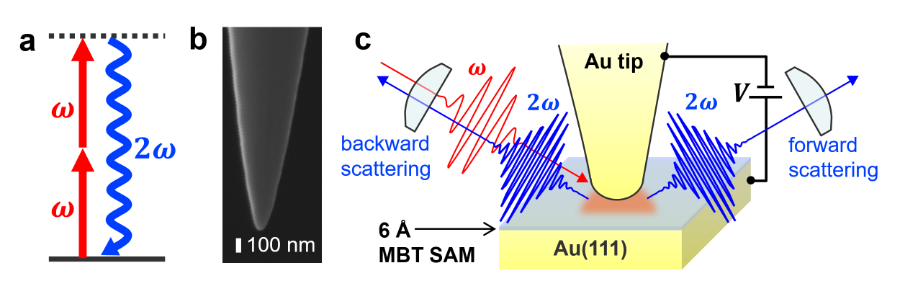
Figure 1: Near-field SHG experiments in the angstrom-scale plasmonic junction of STM.
a Energy level diagram of SHG process. b Scanning electron micrograph of the Au tip used in the experiments. c Schematic depiction of near-field SHG experiment. A Au tip and a Au substrate were mounted on an STM unit and formed an angstrom-scale gap with an applied bias voltage V. The gap region was irradiated by femtosecond near-IR laser with a frequency of ω, and near-field SHG with a frequency of 2ω was detected in both forward- and backward-scattering geometries.
Image credit: Adapted from Takahashi et al. (2026), Nature Communications, CC BY 4.0
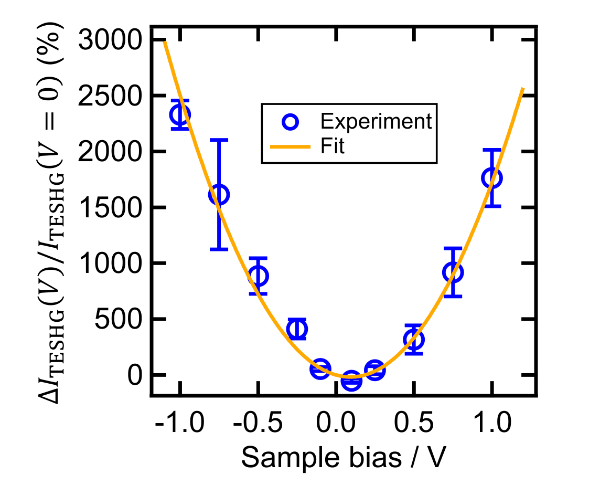
Figure 2: Giant electric modulation of SHG.
The voltage-dependent change in the SHG intensity (ΔITESHG (V)) normalized by the signal intensity at V = 0 V (ΔITESHG (V)) is depicted by blue open circles. The modulation depth of ~2000% is achieved at a bias voltage of ±1 V. The orange curve is the result of curve fitting with a quadratic function. The measurements were performed in the backward-scattering geometry under constant excitation intensity (0.5 mW) and constant tip-substrate distance (~7 Å).
Image credit: Adapted from Takahashi et al. (2026), Nature Communications, CC BY 4.0
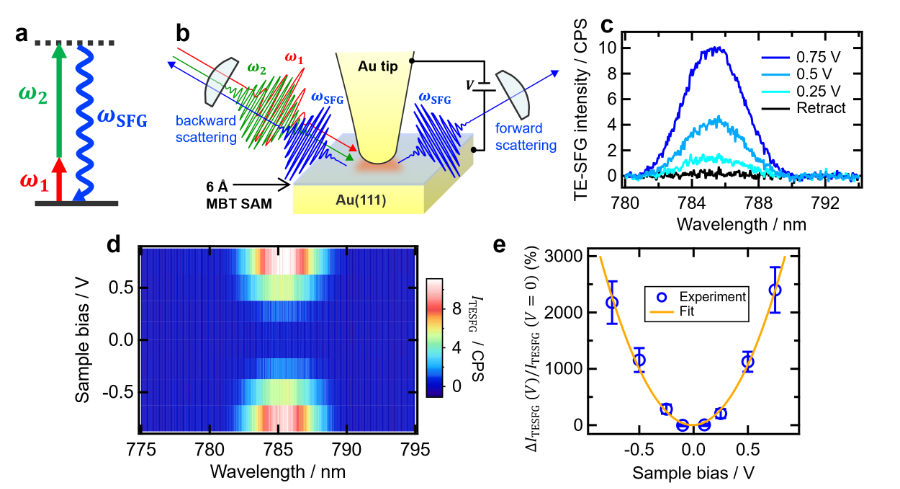
Figure 3: Giant electric modulation of SFG process.
a Energy level diagram of SFG process. Two-photon excitation with mid-IR (ω1) and near-IR (ω2) light induces radiation at the sum frequency of those light (ωSFG=ω1+ω2) b Schematic depiction of the near-field SFG experiment using a Au tip and a Au substrate mounted on an STM unit. c TE-SFG spectra obtained at sample biases of 0.25 V (cyan), 0.5 V (sky blue), and 0.75 V (dark blue) with a constant tunnelling current setpoint of 250 pA. The black curve indicates the signal obtained when the tip and the substrate were retracted enough (30 nm) to deactivate the plasmonic enhancement effects. d Two-dimensional plot of TE-SFG spectra obtained with the various applied sample bias under the almost constant tip-substrate distance (d~7 Å). e The voltage-dependent change in the TE-SFG output (ΔITESHG (V)) normalized by the TE-SFG signal intensity at V = 0 V (ITESHG (V = 0)) is depicted by blue open circles. The orange curve is the result of curve fitting with a quadratic function.
Image credit: Adapted from Takahashi et al. (2026), Nature Communications, CC BY 4.0
Paper information:
Authors: Shota Takahashi, Atsunori Sakurai, Tatsuto Mochizuki, and Toshiki Sugimoto
Journal Name: Nature Communications
Journal Title: "Giant near-field nonlinear electrophotonic effects in an angstrom-scale plasmonic junction"
DOI: 10.1038/s41467-026-68823-4
Financial Support:
JST PRESTO (JPMJPR1907)
JST CREST (JPMJCR22L2)
The grant of OML project by the National Institute of Natural Sciences (NINS program No. OML032501)
Special Project by the Institute for Molecular Science (IMS program 25IMS1101)
JSPS KAKENHI
Grant-in-Aid for Scientific Research (A) (JP19H00865 and JP22H00296)
Grant-in-Aid for Scientific Research (B) (JP23H01855)
Grant-in-Aid for Transformative Research Areas (A) (JP24H02205)
Grant-in-Aid for Challenging Research (Exploratory) (JP24K21759)
Grant-in-Aid for JSPS Fellows (JP22KJ3099)
Contact Person:
Name: Toshiki Sugimoto
TEL: +81-564-55-7280
E-mail: toshiki-sugimoto_at_ims.ac.jp (Please replace the "_at_" with @)
Name: Atsunori Sakurai
TEL: +81-564-55-7287
E-mail: asakurai_at_ims.ac.jp (Please replace the "_at_" with @)
Name: Shota Takahashi
TEL: +81-564-55-7287
E-mail: s-takahashi_at_ims.ac.jp (Please replace the "_at_" with @)
3971