【Overview】
The research group of Associate Professor Yasutomo Segawa and Assistant Professor Takashi Harimoto at the Institute for Molecular Science (National Institutes of Natural Sciences) and the Graduate University for Advanced Studies (SOKENDAI) has developed a new method for selectively synthesizing three-dimensional macrocycles,⁽¹⁾ in which four panels are arranged in a square, by connecting planar π-conjugated molecules⁽²⁾ at right angles.
This method is applicable to a wide variety of π-conjugated molecules and allows the size of the internal cavity to be designed. Furthermore, the resulting square macrocycles exhibit acid responsiveness, reversibly changing color under the action of a mild acid, while acid-mediated hydrolysis enables the starting monomers to be recovered in high yield--realizing a sustainable molecular synthesis that reverts to and regenerates the starting materials. The originality of this work lies in having a single imine bond⁽³⁾ play three roles: creating the shape, responding to stimuli, and reverting back.
These research results were published online in the Journal of the American Chemical Society, an international journal of the American Chemical Society, on Monday, June 1, 2026.
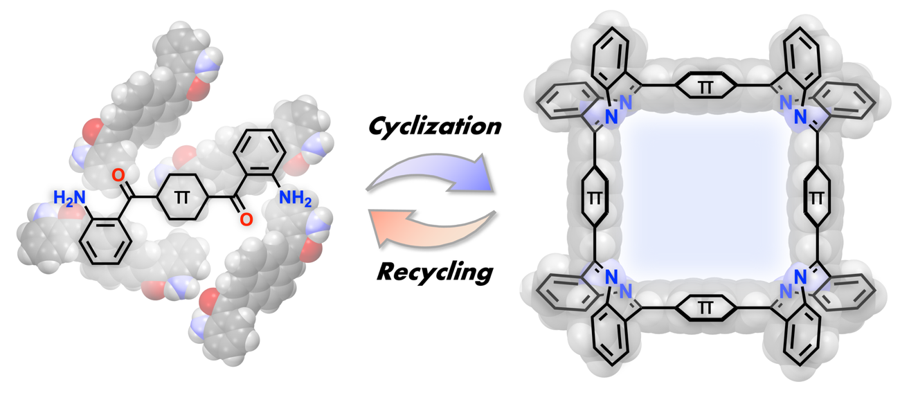
Graphical abstract of this research
(Credit: Takashi Harimoto, Yasutomo Segawa, Restriction: CC BY)
1. Research Background
Three-dimensional macrocycles, in which planar π-conjugated molecules stand in a ring-like arrangement and are connected to one another, are attracting worldwide attention as functional molecules expected to find applications across a broad range of fields--including organic electronics, molecular recognition, and catalysis--owing to their distinctive structures that possess an internal cavity.
Most of the three-dimensional π-conjugated macrocycles synthesized to date adopt nearly circular shapes because the structural strain is distributed evenly throughout the entire molecule. To create polygonal structures, a molecular design that relieves the strain at specific positions is required. In a triangle, the angle between adjacent panels is 60°, and because this angle can be produced from the natural bond angle (approximately 120°) between the sp2 elements⁽⁴⁾ that make up planar molecules, triangular macrocycles have been known to be relatively easy to synthesize (Figure 1a). A square, on the other hand, which consists of four sides and four corners, requires producing an angle of approximately 90° between adjacent panels--a value that deviates from the natural bond angle--and its synthesis had long been a challenge.
In recent years, pioneering synthetic methods using bent molecular frameworks as linkers have been reported. However, many issues remained, such as reduced yields due to side reactions, deformation away from the square structure, and the limited range of applicable π-conjugated molecules. Moreover, because these macrocycles are synthesized through irreversible carbon-carbon bond formation, recovering and reusing the starting materials from byproducts is difficult, and improvements were also called for from the standpoint of resource efficiency.
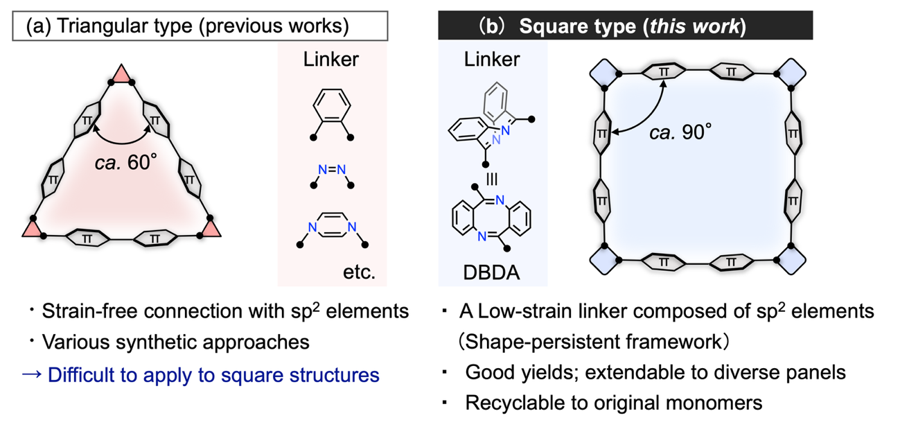
Figure 1. Polygonal three-dimensional π-conjugated macrocycles. (a) Triangular structures: various linkers have been reported. (b) Square structures: challenges remained in their synthetic approach.
(Credit: Takashi Harimoto, Yasutomo Segawa, Restriction: CC BY)
2. Research Results
The research group focused on the dibenzo[b,f][1,5]diazocine (DBDA) framework, in which an eight-membered ring (a ring composed of eight atoms) contained within the molecule folds into a boat shape to generate an angle of approximately 90°. By employing this framework as a right-angle linker, they devised a new molecular design strategy that assembles macrocycles in which four π-conjugated panels are arranged in a square (Figure 1b). Quantum-chemical (density-functional-theory) calculations predicted that the tetramer⁽⁵⁾ bearing four DBDA units would adopt the desired square structure and, in addition, would be the most stable compared with other oligomers.
The synthesis of the macrocycles was carried out using, as the key reaction, an imine bond formation reaction in which the amino groups (NH₂) and carbonyl groups (C=O) of the monomers combine under acidic conditions. As a result, a square macrocycle with benzene as the π-conjugated panels was successfully synthesized in a high yield of 60% as a mixture of diastereomers differing in the orientation of the DBDA units (Figure 2a). Further purification allowed a single diastereomer to be isolated, and single-crystal X-ray diffraction analysis confirmed that it adopted the expected square structure with the planarity of the π-conjugated panels maintained (Figure 2b). This is a groundbreaking achievement that greatly improved the synthetic efficiency of square macrocycles, which conventional methods had been limited to producing in low yields due to side reactions. This method is applicable to molecules bearing one benzene ring per side (cycB1₄) as well as molecules containing diverse π-conjugated units such as two benzene rings (cycB2₄), three (cycB3₄), and even pyrene rings (cycP1₄), demonstrating that it is a versatile synthetic strategy in which the size of the internal cavity can be systematically varied.
Spectroscopic measurements demonstrated that the obtained macrocycles possess reversible acid responsiveness: upon addition of an acid (trifluoroacetic acid), the imine bonds react with the acid and the color changes from colorless to yellow-orange, returning to colorless upon neutralization with a base (Figure 2c). Furthermore, it was found that when the mixture of oligomers (byproducts) generated in the reaction was treated in a mixed solvent of an organic solvent and an acidic aqueous solution, the imine bonds were hydrolyzed and the starting monomers could be recovered in high yields of 85-93% (Figure 2d). This is a groundbreaking feature that enables regeneration into the starting monomers--something that could not be achieved with conventional syntheses based on the irreversible formation of carbon-carbon bonds.
The key point of this study is that a single type of bond (the imine bond) is made to play three roles: synthesis, physical properties, and reuse. By harnessing imine bond formation for the efficient construction of the right-angle linker, the researchers achieved shape control; by exploiting the reaction with acid for a reversible color change, they achieved acid responsiveness; and by exploiting bond cleavage under acidic conditions containing water, they achieved recyclability.
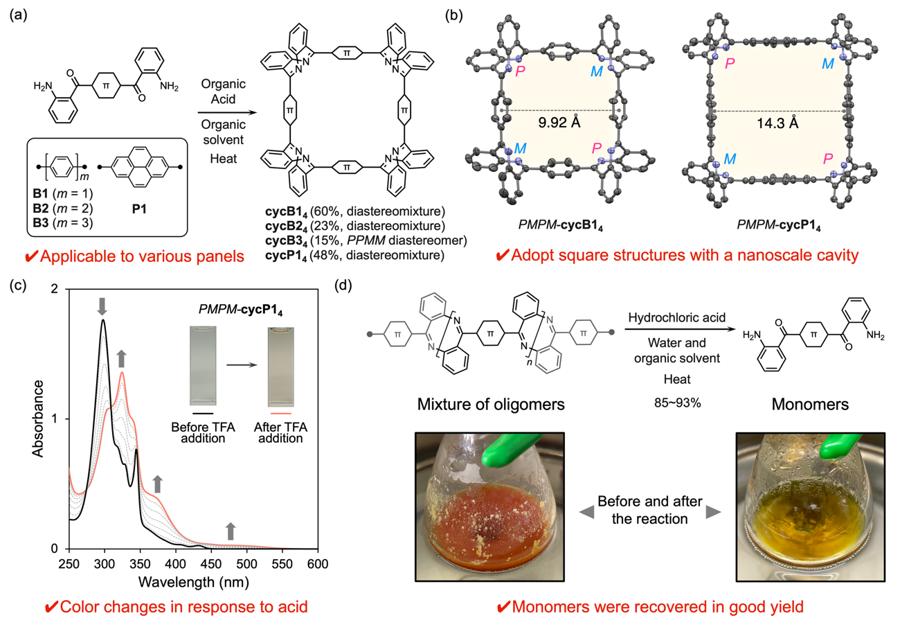
Figure 2. Overview of this study. (a) Synthesis of diverse macrocycles. (b) Identification of the square structure by single-crystal X-ray diffraction analysis. (c) Demonstration of acid responsiveness using spectroscopic measurements. (d) Acid-mediated hydrolysis of the byproducts and its appearance.
(Credit: Takashi Harimoto, Yasutomo Segawa, Restriction: CC BY)
3. Future Prospects and Social Significance of This Research
This method is a synthetic strategy that produces near-right angles using only the sp² elements that constitute π-conjugated molecules, and a major feature is that it requires neither metallic elements nor sp³ elements. In addition, because the starting materials can be recovered through hydrolysis of the byproducts, it can be regarded as a resource-efficient synthetic method. This strategy can be extended beyond squares to the precise synthesis of π-conjugated molecules with a variety of three-dimensional structures. The obtained family of compounds possesses internal space and acid responsiveness, and is expected to serve as a new platform that deepens our understanding of the structure-property relationships of π-conjugated macrocycles, thereby contributing to the advancement of synthetic organic chemistry and materials science.
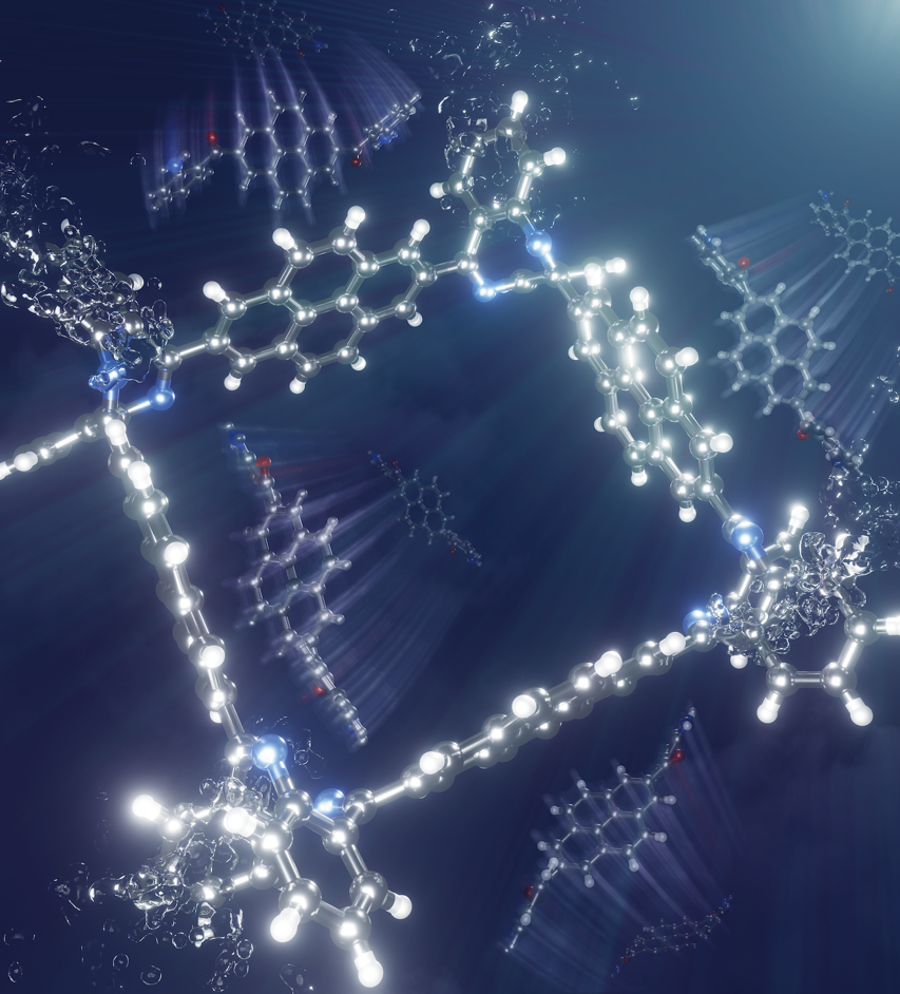
An artwork for this research
(Credit: Takashi Harimoto, Yasutomo Segawa, Norifumi Kosaka (YAP Co., Ltd), Restriction: CC BY)
4. Glossary
(1) Macrocycle
A general term for molecules possessing a large ring in which numerous atoms are connected in a cyclic fashion.
(2) π-conjugated molecule
A planar organic compound in which numerous double bonds and aromatic rings are arranged in succession. It has the property of electrons spreading across the entire molecule and is widely used as a foundation for familiar products such as plastics, pharmaceuticals, and organic light-emitting diodes (OLEDs).
(3) Imine bond
A double bond between carbon (C) and nitrogen (N) (C=N). It is formed when the amino group (NH2) and the carbonyl group (C=O) of the monomers combine with the loss of water. It is known as a reversible bond that can be cleaved again under the action of acid and water.
(4) sp² element
An atom that adopts an sp² hybrid orbital. It has the property of extending three bonds at angles of approximately 120° in the same plane, and applies to a variety of elements such as carbon and nitrogen. It forms the basic structure of π-conjugated molecules such as benzene.
(5) Tetramer
A molecule formed by the bonding of several unit molecules (monomers) is called an oligomer, and oligomers are named according to the number of units bonded together: dimer (2 units), trimer (3 units), tetramer (4 units), and so on.
5. Article Information
Journal: Journal of the American Chemical Society
Title: Construction of Shape-Persistent All-sp² Square Macrocycles via the Formation of Multiple Imine Bonds
Authors: Takashi Harimoto*, Yasutomo Segawa* (*Corresponding authors)
Publication date: June 1, 2026 (online publication)
DOI: 10.1021/jacs.6c02905
6. Research Group
Institute for Molecular Science, National Institutes of Natural Sciences
The Graduate University for Advanced Studies (SOKENDAI)
7. Research Support
JST FOREST Program
JPMJFR211R
JSPS KAKENHI Grant-in-Aid for Scientific Research (B)
JP25K01758
JSPS KAKENHI Grant-in-Aid for Research Activity Start-up
JP24K23093
JSPS KAKENHI Grant-in-Aid for Early-Career Scientists
JP25K18023
The Murata Science and Education Foundation
The Iketani Science and Technology Foundation
The Foundation of Public Interest of Tatematsu
The Yazaki Memorial Foundation for Science and Technology
The TOBE MAKI Foundation
Institute for Molecular Science, Research Project
JPMXP1225MS5001
Mass spectrometry was performed using shared equipment at the Equipment Sharing Division, Organization for Co-Creation Research and Social Contributions, Nagoya Institute of Technology.
Quantum-chemical calculations were performed using the resources of the Research Center for Computational Science, Okazaki Research Facilities, National Institutes of Natural Sciences
25-IMS-C297
8. Contact
Yasutomo Segawa
Institute for Molecular Science, National Institutes of Natural Sciences
E-mail: segawa_at_ims.ac.jp (Please replace the "_at_" with @)
4622