summary:
- ・ Overcoming a Major Hurdle: The research team in Institute for Molecular Science, Core for Spin Life Sciences, Khon Kaen University and The Graduate University for Advanced Studies has discovered a new electrolyte that facilitates the fluorination reaction, a major barrier in the development of fluoride shuttle batteries, which are highly anticipated as next-generation, high-energy-density batteries.
- ・ Unlocking the Activity: By using potassium tetrafluoroborate in the electrolyte, researchers increased the availability of active fluoride ions, successfully enabling charging and discharging (fluorination and defluorination) reactions.
- ・ A Sustainable Path Forward: Because potassium tetrafluoroborate is both chemically stable and inexpensive, it provides a new guideline for electrolyte design. This breakthrough paves the way for realizing sustainable, low-cost and high-energy storage systems.
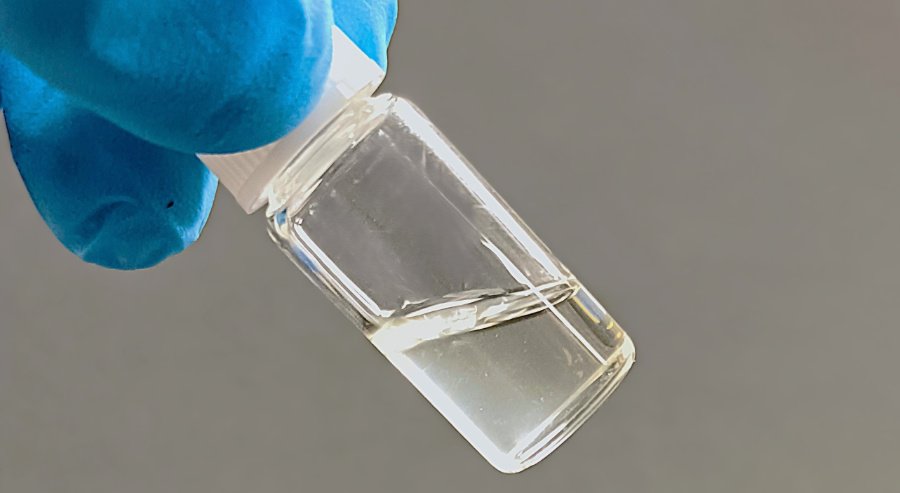 Figure: The electrolyte for fluoride shuttle batteries using potassium tetrafluoroborate.
A research team including Taketoshi Minato (Institute for Molecular Science and Core for Spin Life Sciences), Nicha Tabtimtong (Khon Kaen University and Institute for Molecular Science), Pattanapon Kaisook (Khon Kaen University and Institute for Molecular Science), Yumiko Imai (Institute for Molecular Science), Tadashi Ueda (Institute for Molecular Science), Kei-ichi Nakamoto (Institute for Molecular Science, currently Nara Institute of Science and Technology), Yasutomo Segawa (Institute for Molecular Science and The Graduate University for Advanced Studies (SOKENDAI)), Arthit Neramittagapong (Khon Kaen University), and Sutasinee Neramittagapong (Khon Kaen University) has successfully designed a novel electrolyte for fluoride shuttle batteries based on a new concept.
With global demand rapidly increasing for high-energy-density and low-cost energy storage technologies, the investigation for new systems to replace conventional lithium-ion batteries is accelerating. Fluoride shuttle batteries have garnered significant attention as a highly promising next-generation candidate. They boast an extremely high theoretical energy density and can be manufactured using inexpensive, abundant materials found in the Earth's crust. The key feature of these batteries is how they operate: they store and release energy by shuttling fluoride ions back and forth between the electrodes.
However, a major issue with this battery system is that the "fluorination reaction" is much harder to trigger than the opposing "defluorination reaction." During fluorination, unwanted side reactions and irreversible processes often occur, causing the battery's performance to decline. Therefore, a crucial challenge has been figuring out how to make this reaction proceed smoothly, and what kind of electrolyte design is needed to achieve that.
To promote the fluorination reaction, a thought is to increase the concentration of fluoride ions in the electrolyte. However, stable inorganic fluoride salts generally do not dissolve well in organic solvents, making it difficult to achieve a high enough concentration. It has been tried adding specific organic molecules designed to bind to fluoride ions to help them dissolve. These molecules are often expensive, difficult to synthesize, and can sometimes trap the fluoride ions too tightly, ironically hindering the very fluorination reaction they were meant to help.
To tackle this problem, the research team focused on a different fluorine-containing inorganic salt: potassium tetrafluoroborate (KBF4). Because KBF4 is chemically stable and it is reported to act as fluoride sources in chemical reactions, the team hypothesized that it might effectively regulate the fluorination reaction at the boundary where the electrode meets the electrolyte.
First, the team discovered that by adding both cesium fluoride (CsF) and KBF4 to an organic solvent (tetraglyme), the amount of Cs ions successfully increased dramatically compared to when KBF4 was not used. This suggested that KBF4 boosts the solubility of fluoride salts and fundamentally changes the state of the fluoride ions in the electrolyte.
Next, the team tested the newly prepared electrolyte and confirmed that it possesses high electrochemical stability. Furthermore, using analytical techniques, such as cyclic voltammetry and X-ray photoelectron spectroscopy on a bismuth metal electrode, they successfully observed reversible fluorination and defluorination reactions. These results proved that the KBF4-containing electrolyte is highly effective at driving the necessary electrode reactions for fluoride shuttle batteries.
Moreover, in practical charge-discharge measurements, this new electrolyte clearly supported reversible reactions in a bismuth fluoride-composite electrode. Notably, the potential at which the fluorination reaction occurred with this new electrolyte was significantly more negative than in previous systems that used organic additives. This indicates that the KBF4 electrolyte is controlling fluoride ion activity and electrode reactions in a fundamentally different and improved way.
These findings demonstrate that KBF4 is effectively controlling fluoride ion activity within a battery with a chemically robust and low-cost additive capable. It is highly likely that this new electrolyte activates the fluorination reaction by uniquely altering the state of the fluoride ions and the electrode. The team are investigating further detailed research to deepen the understanding of exactly how this mechanism works.
Ultimately, this study presents a fresh, simple, and scalable approach to designing electrolytes for fluoride shuttle batteries, using materials quite different from previous methods. By proving that a KBF4-based electrolyte enables reversible electrode reactions, this research marks a vital step forward. As scientists continue to improve the electrolyte, optimize electrode structures, and stabilize the internal environment of the battery, it can be expected even greater improvements in capacity, lifespan, and practicality--bringing us closer to a future powered by sustainable, next-generation energy storage.
Information of the paper
Authors: Nicha Tabtimtong, Pattanapon Kaisook, Yumiko Imai, Tadashi Ueda, Kei-ichi Nakamoto, Yasutomo Segawa, Arthit Neramittagapong, Sutasinee Neramittagapong, and Taketoshi Minato
Journal Name: ACS Applied Energy Materials
Journal Title: "Facilitated Fluorination by Potassium Tetrafluoroborate in Tetraglyme Electrolytes for Fluoride Shuttle Batteries"
DOI: 10.1021/acsaem.5c04132
Funding
OML Project by the National Institutes of Natural Sciences (NINS), OML032301
Advanced Research Infrastructure for Materials and Nanotechnology in Japan (Ministry of Education, Culture, Sports, Science and Technology (MEXT), Japan), JPMXP1224MS0014, JPMXP1224MS1061, JPMXP1224MS1064, JPMXP1225MS1021, JPMXP1225MS0005, JPMXP1225MS3005
Related Researcher
Institute for Molecular Science
Khon Kaen University
Institute for Molecular Science
Khon Kaen University
Institute for Molecular Science
Institute for Molecular Science
Institute for Molecular Science
Institute for Molecular Science
Current: Nara Institute of Science and Technology
Institute for Molecular Science
The Graduate University
for Advanced Studies (SOKENDAI)
NERAMITTAGAPONG,
Sutasinee