Overview
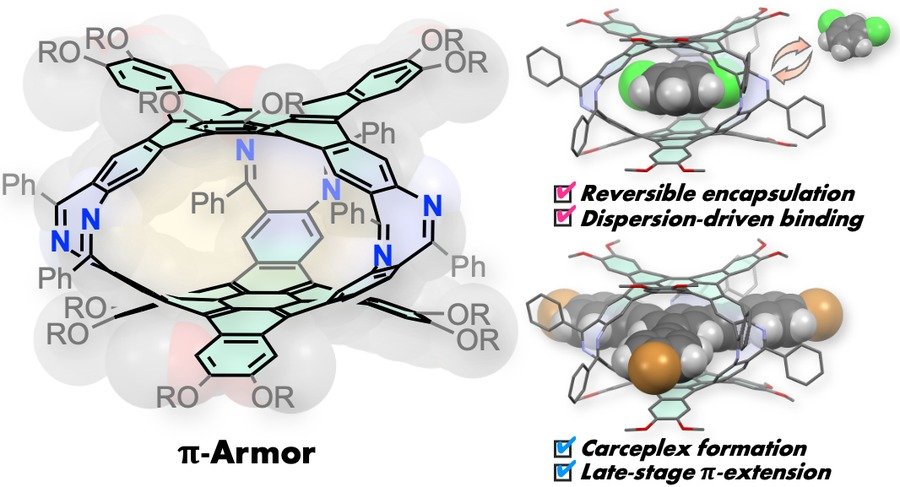
A research team comprising Associate Professor Yasutomo Segawa, Assistant Professor Takashi Harimoto, and graduate student Haruka Kano of the Institute for Molecular Science (IMS), National Institutes of Natural Sciences, and The Graduate University for Advanced Studies, SOKENDAI, has designed and synthesized a molecular cage with an internal cavity by connecting two curved π-conjugated molecules (1) face-to-face at three points.
The cage takes up a range of π-conjugated guest molecules through three orifices in its sides and sandwiches them between two π-conjugated panels. Guests small enough to pass through the orifices can enter and leave reversibly, and bind more strongly as their shapes better match the cavity. Larger guests that cannot pass through the orifices are instead incorporated as the cage is assembled, forming carceplexes (2) from which the guests cannot escape even upon heating under reduced pressure. A distinctive achievement of this study is the permanent encapsulation of planar π-conjugated molecules through molecular shape complementarity, irrespective of the guests' electronic properties--a longstanding challenge.
Because the two π-conjugated panels enclose the guest like armor, the researchers named this molecule "π-Armor." The approach may enable the design of molecular capsules with diverse functions, including the protection of unstable molecules and the development of new molecular materials.
The research findings were published online in the American Chemical Society journal Journal of the American Chemical Society on October 13, 2026.
1. Background
The field that studies molecules that capture other molecules (hosts) and the molecules they capture (guests) is known as host-guest chemistry (3) . The ability of one molecule to recognize and bind a particular partner is being studied worldwide because of its potential applications in sensing, separation, catalysis, medicine, and many other areas.
Hosts capture guests in two principal ways (Figure 1a). One is reversible encapsulation, in which a guest repeatedly binds to and dissociates from a host. The other is permanent encapsulation, in which the guest is incorporated while the host is being assembled and cannot escape afterward. Permanent encapsulation was first reported by Dr. Donald Cram in 1985. A pioneer of host-guest chemistry, Cram received the Nobel Prize in Chemistry in 1987. The resulting complexes, known as carceplexes, can perform distinctive functions, such as stably retaining molecules that would otherwise be unstable.
Many hosts capable of reversibly capturing planar π-conjugated molecules have been developed using various types of noncovalent interactions. However, very few carceplexes that permanently encapsulate planar π-conjugated molecules have been reported. Those rare examples depend on the attraction between electron-rich guests and electron-deficient hosts, limiting the types of molecules that can be trapped. They also yield mixtures of guest-filled and empty hosts rather than carceplexes selectively. Permanently trapping planar π-conjugated molecules through shape complementarity, without depending on guest electronic properties, has therefore remained a longstanding challenge.
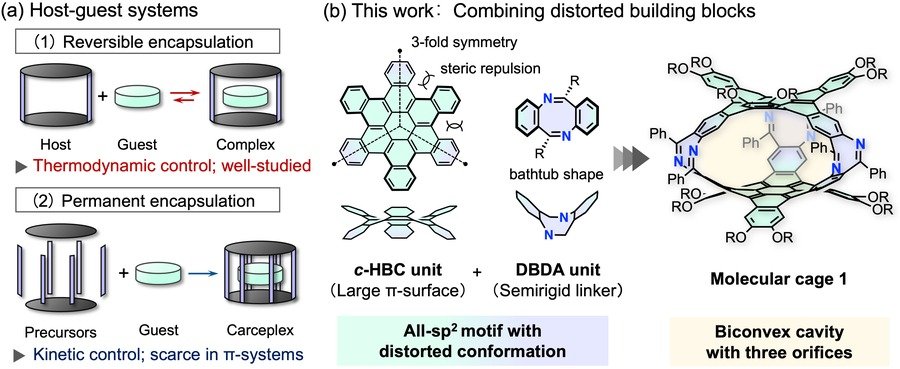
Figure 1. Two modes of guest encapsulation in host-guest chemistry and the molecular design developed in this study. (a) Reversible encapsulation and permanent entrapment. (b) Design of a molecular cage from curved panel molecules (c-HBC) and bent bridging units (DBDA).
2. Research Findings
The research team focused on hexa-cata-hexabenzocoronene (c-HBC), a π-conjugated molecule composed of many fused benzene rings that adopts a curved, monkey-saddle-shaped structure. The team designed a molecular cage with an internal cavity by connecting two c-HBC panels at three points using dibenzodiazocine (DBDA), a bent eight-membered-ring framework (Figure 1b). Reacting precursor molecule 2 under acidic conditions formed all three DBDA bridges in one step, yielding cage molecule 1 in 55% yield (Figure 2a). Quantum-chemical calculations suggested that the two c-HBC panels face one another in parallel, approximately 6.3 Å apart, with three side orifices approximately 10 Å wide (Figure 2b).
Cage 1 reversibly captured π-conjugated guests small enough to pass through the orifices, holding them between the two π-conjugated panels (Figure 2c). The strength of association varied markedly with guest shape (Figure 2d). Among dichlorobenzene guests, the meta isomer, with chlorine atoms at the 1,3-positions of the benzene ring, bound about 90 times more strongly than the para isomer, whose chlorine atoms occupy opposite positions. Comparing different halogen substituents (4) at the meta positions, chlorine- and bromine-substituted guests showed similarly strong association, whereas guests bearing fluorine (too small) or iodine (too large) bound more weakly. A guest bearing two electron-donating methyl groups at the meta positions was also encapsulated, despite its electronic properties being opposite to those of the halogen-substituted guests.
These guests were able to enter and leave the cage through the orifices, and adding a more strongly binding guest caused the encapsulated molecule to be exchanged. Theoretical calculations indicated that the binding is primarily supported by dispersion forces (5) . Association was strongest when the two meta substituents fitted into two orifices and their sizes most closely matched the host cavity.
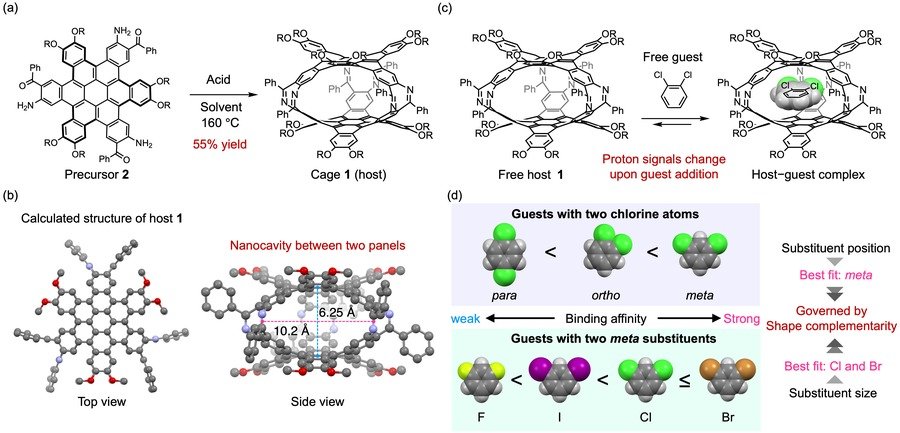
Figure 2. Synthesis of the molecular cage and reversible encapsulation of guest molecules. (a) Synthesis of molecular cage (host) 1. (b) Structure of host 1 predicted by quantum-chemical calculations. (c) Reversible guest encapsulation (illustrated with an ortho-dichlorobenzene guest). (d) Differences in binding affinity according to guest shape.
In contrast, guests bearing three substituents at alternating 1,3,5-positions could not pass through the orifices and were not taken up by the preformed cage. Noting that their three substituents would fit the three orifices, the researchers synthesized the cage in the presence of these guest molecules. This produced carceplexes containing permanently trapped guests in yields of up to 57%, with no empty cage detected (Figure 3a). The carceplexes did not release their guests even when heated to 200 °C under reduced pressure. Molecules with three electron-donating methyl groups could be trapped in the same way as halogen-containing molecules, indicating that permanent encapsulation depends on shape complementarity rather than the guests' electronic properties.
The team also trapped a larger π-conjugated guest bearing three arms that extended beyond the cavity, forming a structure in which the arms protruded through the three orifices. While the guest remained trapped, chemical reactions at the tips of these arms attached additional aromatic rings, further extending its π-conjugated system (Figure 3b). This is an important demonstration that an encapsulated molecule can still be chemically modified after entrapment.
The key advance is the permanent encapsulation of planar π-conjugated molecules based on matching molecular shapes, independent of the guests' electronic properties. Both reversible and permanent encapsulation are stabilized by dispersion arising from shape complementarity. The researchers therefore named this new host "π-Armor": a cage that behaves like armor by sandwiching a π-conjugated guest between π-conjugated panels.
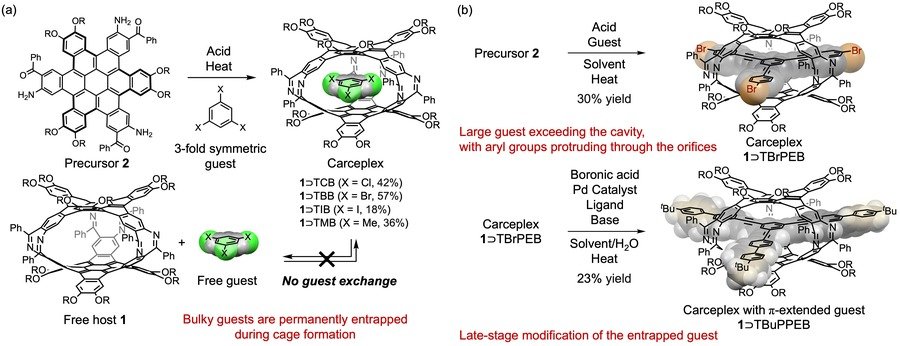
Figure 3. Synthesis of carceplexes and chemical transformation of entrapped guests. (a) Synthesis of various carceplexes. (b) Permanent entrapment of a guest large enough to protrude through the orifices, followed by its chemical modification.
3. Future Outlook and Societal Significance
This strategy exploits the cage-assembly process to permanently encapsulate π-conjugated molecules through shape complementarity, independently of the electronic properties of the guest. Because guests can be chemically modified even after entrapment, the molecular structures housed inside the cage can be designed with considerable flexibility. The strategy offers a new design principle for molecular capsules that enclose π-conjugated molecules. By imparting optical or electronic functions derived from the trapped guests, or by protecting unstable molecular species, it is expected to contribute to progress in host-guest chemistry and materials science.
4. Glossary
(1) π-Conjugated Molecules
Organic compounds containing alternating single and double bonds and/or aromatic rings. Their π-electrons are delocalized across multiple bonds. Such molecules are widely used as the basis of materials that interact with light or electricity, including organic light-emitting devices (OLEDs), organic solar cells, and dyes.
(2) Carceplex
A complex in which a guest is trapped inside a host molecule and cannot escape without breaking a covalent bond of the host. Carceplexes were first reported by Dr. Donald Cram in 1985. The name derives from the Latin word carcer, meaning "prison."
(3) Host-Guest Chemistry
A field of chemistry concerned with complexes formed when a host molecule captures a guest molecule or ion without forming a covalent bond between them. Hosts and guests are generally held together by interactions weaker than covalent bonds, such as hydrogen bonding, electrostatic interactions, and dispersion forces. Host-guest chemistry is fundamental to molecular recognition, in which a molecule selectively recognizes and binds a partner, and is a central field of supramolecular chemistry, the study of structures and functions formed by assemblies of molecules.
(4) Substituent
An atom or group of atoms attached to a molecular framework in place of a hydrogen atom (here, on a benzene ring). In this study, examples include halogen atoms such as chlorine and bromine, and methyl groups. The identity and position of substituents affect molecular shape and properties.
(5) Dispersion Forces
Weak attractive forces acting between all molecules; they are a type of van der Waals interaction. Although each individual interaction is weak, extensive contact between relatively flat molecular surfaces can result in substantial overall stabilization.
5. Publication Details
Journal: Journal of the American Chemical Society
Article title: π-Armor: Shape-Complementary Encapsulation of Aromatics
Authors: Haruka Kano, Takashi Harimoto*, Yasutomo Segawa* (*Corresponding authors)
Publication date: October 13, 2026 (published online)
DOI: 10.1021/jacs.6c17351
6. Research Institutions
Institute for Molecular Science (IMS), National Institutes of Natural Sciences (NINS)
The Graduate University for Advanced Studies, SOKENDAI
7. Funding and Research Support
JST, FOREST program, JPMJFR211R
JSPS, KAKENHI Grant-in-Aid for Scientific Research (B), JP25K01758
JSPS KAKENHI Grant-in-Aid for Research Activity Start-up, JP24K23093
JSPS KAKENHI Grant-in-Aid for Early-Career Scientists, JP25K18023
Murata Science and Education Foundation
Iketani Science and Technology Foundation
Foundation of Public Interest of Tatematsu
Yazaki Foundation
TOBE MAKI Foundation
Tokuyama Science and Technology Promotion Foundation
"Advanced Research Infrastructure for Materials and Nanotechnology in Japan (ARIM)" of the Ministry of Education, Culture, Sports, Science and Technology (MEXT), JPMXP1225MS5001
Equipment Sharing Division, Organization for Co-Creation Research and Social Contributions, Nagoya Institute of Technology
Quantum-chemical calculations used resources of the Research Center for Computational Science, Okazaki, Japan (project No. 25-IMS-C297).
8. Contact Person
Yasutomo Segawa
Institute for Molecular Science, National Institutes of Natural Sciences / SOKENDAI
E-mail: segawa_at_ims.ac.jp (Please replace the "_at_" with @)
4622