| Abstract |

Electrochemical reactions on van der Waals (vdW) materials are strongly influenced by local electronic structure and interfacial heterogeneity, yet these effects are often hidden in ensemble-averaged measurements [1]. In this study, multimodal nanoscale characterization is employed to correlate local structure, morphology, and electrochemical activity at vdW interfaces. Figure 1 presents representative correlative mapping results obtained on monolayer MoS₂ using AFM–SECM operated in feedback mode [2]. Optical microscopy, AFM topography, and electrochemical current mapping visualize spatial variations across identical regions of the sample. The mechanistic interpretation, including layer-dependent charge-transfer behavior governed by local electronic structure, is established through comprehensive analysis in our previous nanoscale redox mapping study at MoS₂–liquid interfaces [2]. This correlative approach is further applied to hydrogen evolution reactions on two-dimensional materials and graphene-based systems, where interfacial behavior is found to be strongly influenced by surface wettability and nanobubble dynamics [3]. Hybrid interfaces, such as Ag nanoparticle/graphene oxide structures, show similarly localized activity enhancement, indicating that catalytic performance originates from specific interfacial regions [4]. These observations highlight the importance of nanoscale interfacial heterogeneity in governing electrochemical reactivity. Because different reactions impose distinct constraints on probe stability, transport, and interfacial chemistry, correlative multimodal microscopy must be adapted to reaction-specific environments rather than applied as a fixed technique set. This reaction-adaptive multimodal mapping provides direct insight into structure–activity relationships at electrochemical interfaces and is being extended toward operando correlative measurements under realistic conditions, including vdW-based artificial-leaf architectures where light absorption, charge transport, and catalysis are integrated at atomically defined interfaces.
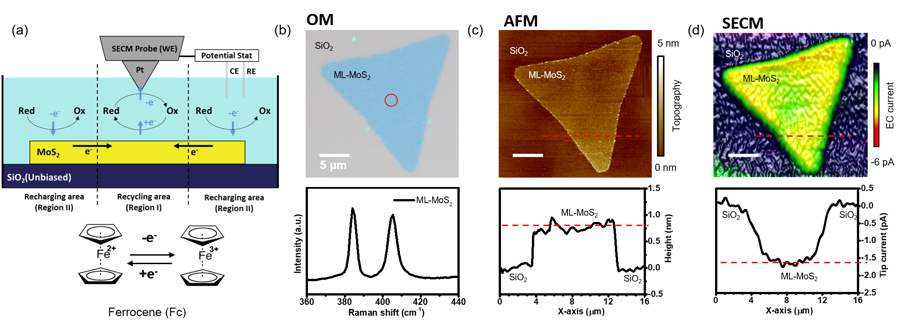
Fig. 1 AFM–SECM feedback-mode measurement and correlative characterization of monolayer MoS₂: (a) measurement schematic, (b) optical image and Raman spectrum, (c) AFM topography and height profile, and (d) SECM current map with corresponding line profile [2].
REFERENCES
[1] H.-C. Hsu and H.-Y. Du, et al. Nanoscale 4, 6337–6342 (2012).
[2] H.-Y. Du, et al. Nat. Commun. 12, 1321 (2021).
[3] S. K. and H.-Y. Du, et al. Electrochim. Acta 493, 144425 (2024).
[4] C.-Y. Huang and H.-Y. Du, et al. J. Taiwan Inst. Chem. Eng. 106357 (2025). |